The audition is tomorrow. You have four pages, a character you met this afternoon, and nobody to run lines with.
Here’s what separates the actors who book from the ones who almost do: the lines are simply there. When you don’t have to reach for the words, you’re free to listen, to take the moment, to try the thing the casting director asks for on the second take. Being off-book isn’t the goal. It’s what lets you act.
And you can get there on your own. Running lines by yourself works, as long as you practise what actually happens in the room: hearing a cue and answering it, out loud, at the speed of the scene. Here are seven ways to do it, from the oldest trick in the book to the ones that keep working when you’re nowhere near the script.
Before you memorise a word
Know why your character says it. Read the whole scene, or the whole script if you have it, and ask what your character wants. Lines learned as sounds fall apart under pressure. Lines learned as the next thing your character has to say come back on their own, even with nerves.
Learn the cues, not just your lines. In the room, your line starts when someone else stops talking. If you only know your own words, you’ll know them in order but not when to say them.
Get the words exactly right. Casting notices when you paraphrase, and so does the writer if they’re in the room. Learn it word for word early; fixing a wrong version later is twice the work.
1. The cover card
The classic. Lay a card or a sheet of paper over the page, slide it down to reveal the other character’s line, say yours out loud, then slide it down to check.
Why it works: you practise remembering, not rereading, and you check yourself line by line.
The catch: you’re reading the cues, not hearing them, and you set the pace, so it’s easy to cheat a little.
2. First letters
Write your lines using only the first letter of each word, keeping the punctuation: "I told you, I’m not going back" becomes "I t y, I n g b." Then run the scene from that sheet.
Why it works: one letter is just enough to jog your memory without giving you the word, so you do the remembering yourself.
The catch: it takes time to write out, and you still need to test yourself with nothing at all.
3. Write it out by hand
Copy your lines out longhand, from memory, then check them against the script and mark every word you got wrong. Repeat until the page comes out clean.
Why it works: it’s slow and precise, and it catches the little words you keep changing.
The catch: it’s silent. It won’t tell you whether you can say the lines at speed with your heart pounding.
4. Record the cues and leave gaps
Record the other characters’ lines into your phone’s voice memos, leaving a pause after each one where your line goes, then play it back and answer.
Why it works: you finally hear the cues instead of reading them, and you can do it on a walk.
The catch: the gaps are fixed. Take longer than you planned and the next cue talks over you; come in quicker and you wait. And it’s your own voice giving you your cues.
5. The speed run
Run the whole scene as fast as you can, with no acting at all: flat, quick, just the words. Theatre companies call it an "Italian run".
Why it works: it exposes the lines you only half know, because there’s no time to hunt for them.
The catch: do it once or twice, not all the time. You still need to rehearse at the pace of the scene.
6. Get it on its feet
Say the lines out loud while you move the way you will in the scene: sitting, standing, crossing the room, picking something up. Words learned with the body attached come back with the body.
Why it works: your lines get tied to actions and places, which is how they’ll come back to you in the room.
The catch: you still need someone, or something, giving you the cues.
7. Little and often
Several short runs beat one long one: ten minutes over breakfast, ten on the bus, ten before bed. Start each run by testing yourself cold, then spend the time on the lines you dropped, not the ones you already have.
Why it works: every session goes straight to your weak spots.
The catch: it takes a little planning. Start as soon as the sides arrive.
How Scene Voice runs lines with you
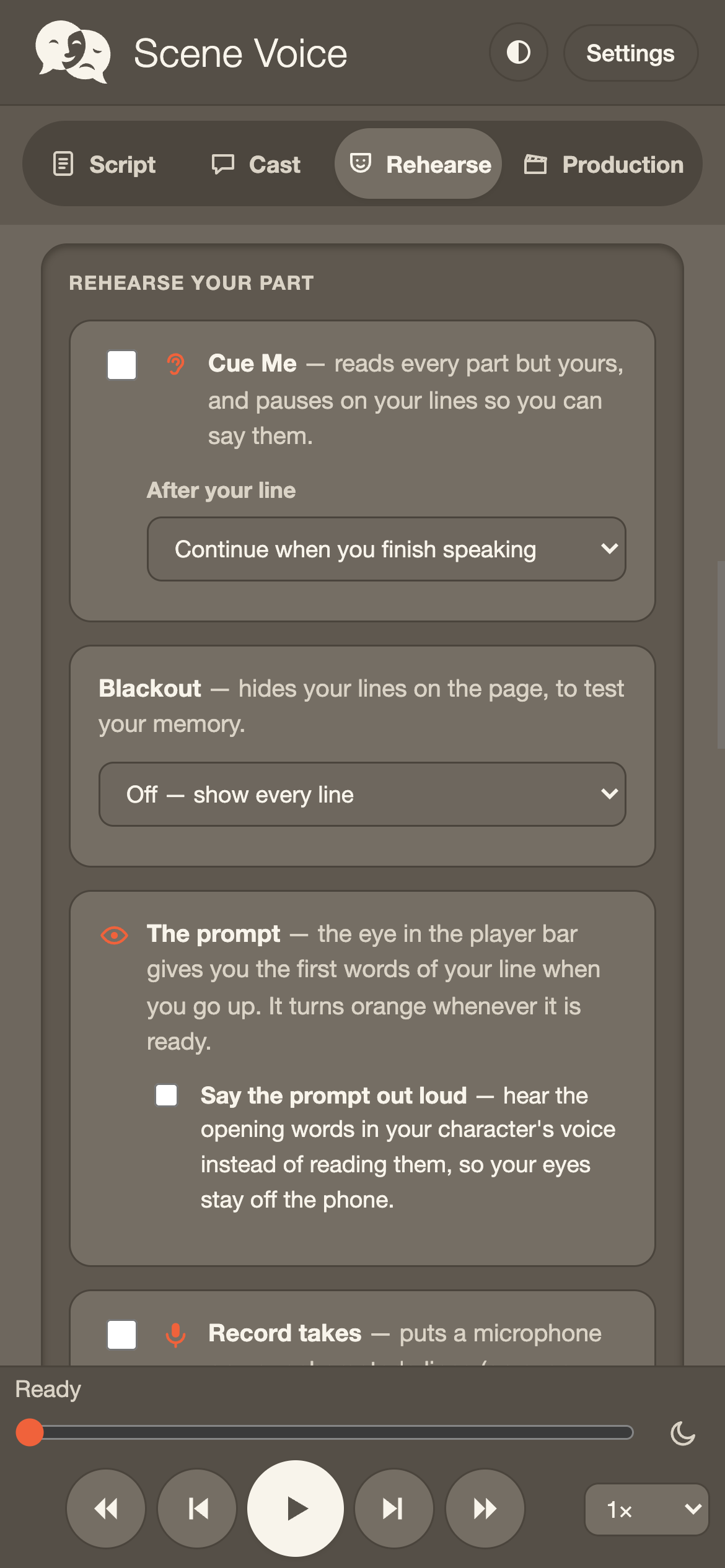
Scene Voice is an iPhone and iPad app we make for exactly this. You import your sides or the whole script, as a PDF or Final Draft file, pick your character, and every other part gets its own voice. Then:
- It waits for you. In Cue Me the app plays every part but yours and stops at your lines. It follows your words, picks up the moment you finish and prompts you if you stop, or waits a beat you choose, so the scene runs at the speed you play it, not the speed of a recording.
- It hides your lines. Blackout hides your lines completely, or leaves just their first letters: the first-letter sheet without writing anything out.
- It prompts you when you go up. Ask for a prompt and you get the opening words, on screen or spoken in your character’s voice, so your eyes can stay off the phone.
- It drills the hard bits. Loop these lines brackets a speech or an exchange and plays it round and round until it sticks, and remembers the brackets for next time.
- It comes on the walk. Export the scene as one audio file with your lines left as silence, just the scenes you name if you like, and run it with headphones and nothing to look at.
- Your sides stay on your phone. Nothing is uploaded and there’s no account.
It’s in a free beta for iPhone and iPad right now. If you’re learning lines this week, we’d love you to try it and tell us what gets in your way.
The short version
Know why your character says every line. Learn the cues as well as the words, and learn them exactly. Say everything out loud, answer cues rather than read them, and spend your time on the lines you drop. Do that, and you walk into the room with the words already there, free to do the only thing they’re really watching for: the acting.
Taping the audition? Read how to shoot a self-tape without a reader.