The sides land at six. The tape is due by nine tomorrow morning. Your usual reader is on a shoot, your flatmate is out, and the scene is a two-hander.
Every actor has had that night. Here’s the good news: a self-tape shot without a reader in the room can look and sound every bit as good as one with a reader, and sometimes better. Casting never sees your reader. They see you listening, taking the line in and answering it as if you’ve never heard it before. If you plan for that, you can tape a scene alone and still give them a performance that books.
This guide covers what a reader really does for your tape, five ways to replace one, and how to set up the shot so the only thing anyone watches is you.
What casting is actually watching
Before you pick a workaround, remember who the tape is for.
- They are watching you listen. Half of acting is reacting. The moment before your line, when the other character’s words land, is often the most revealing moment on the tape.
- They need to hear the cue. Without the other line, your reaction floats and the scene makes no sense.
- They are not watching the reader. On a good tape the reader is quieter than you, off camera, and forgettable. A reader who performs pulls focus.
- They want the notes followed. Framing, slate, file name, deadline: casting asks for them for a reason.
So what you need from a reader comes down to three things: the other lines on the tape, a rhythm that follows you, and somewhere to look.
Option 1: Ask a friend, actor or not
A partner, a flatmate, a neighbour. They don’t need to act, and it’s better if they don’t. Ask them to read flat, a touch quieter than you, standing right beside the lens at your eye height.
The upside: real back-and-forth, and something alive to play off.
The catch: someone has to be free, tonight, for as many takes as you need. And for some jobs the sides are confidential, so check what you’re allowed to share before you hand them over.
Option 2: A reader on a video call
A fellow actor reads from their own home, over a call on a second device, with the sound coming through a small speaker near the camera. Actors trade this favour all the time: you read for them next week.
The upside: a real scene partner when nobody’s in the room.
The catch: call audio lags and compresses, so the rhythm can feel off, and the reader’s voice is recorded through the air, often louder or thinner than you’d like. Put the speaker behind the camera, and turn it down more than feels right.
Option 3: A paid reader service
Professional readers on call, by the session. Good ones know exactly how to support a tape.
The upside: an experienced partner for the audition that really matters.
The catch: cost. A session often runs somewhere between fifteen and forty dollars, which adds up fast in a busy month. You also have to book, and you’re sending the sides to a stranger.
Option 4: Record the other lines yourself
Read the other character’s lines into your phone’s voice memos, leaving a gap after each one for your line, then play it back while you tape.
The upside: free, private, and available at two in the morning.
The catch: the gaps are fixed. Take a beat longer than you planned and the next cue walks all over you; come in faster and you’re left waiting. And it’s your own voice feeding you your cues, which makes it hard to hear them fresh.
Option 5: A reader app
Several apps now read the other lines for you. Before you trust one with an audition, ask three questions:
- Does it wait for you? The best ones listen and pick up when you stop speaking, so the scene moves at your pace, not a pre-recorded one. That’s what lets you take the pause that makes the moment.
- How does the reader get onto the tape? Many apps play the other lines out of the phone’s speaker, and the microphone picks them up from the room, echo and all. Better is when the reader plays in your headphones and is added to the video afterwards, so your voice is recorded clean.
- Where does your script go? Some apps upload your sides to a server to make the voices. If the job is under NDA, check before you import.
Set up the shot like a pro
Whichever option you choose, these make the difference between a tape that looks homemade and one that looks booked:
- Eyeline. Pick a spot just to the side of the lens at your eye height (a piece of tape on the wall or the tripod works) and play the scene to it. Don’t look into the lens unless the notes ask for it.
- Framing. Landscape, chest up, a little headroom. A plain background that says nothing.
- Light. Face a window or put a soft light in front of you, slightly to one side. Never a bright window behind you.
- Sound. A quiet room with soft furnishings beats an expensive microphone. Keep the phone close.
- The reader’s level. Whatever is reading, keep it quieter than you. Casting is watching you, not the other part.
- The notes win. Slate first, full-length shot, a specific file name: if the casting notes say it, do it.
How Scene Voice handles it
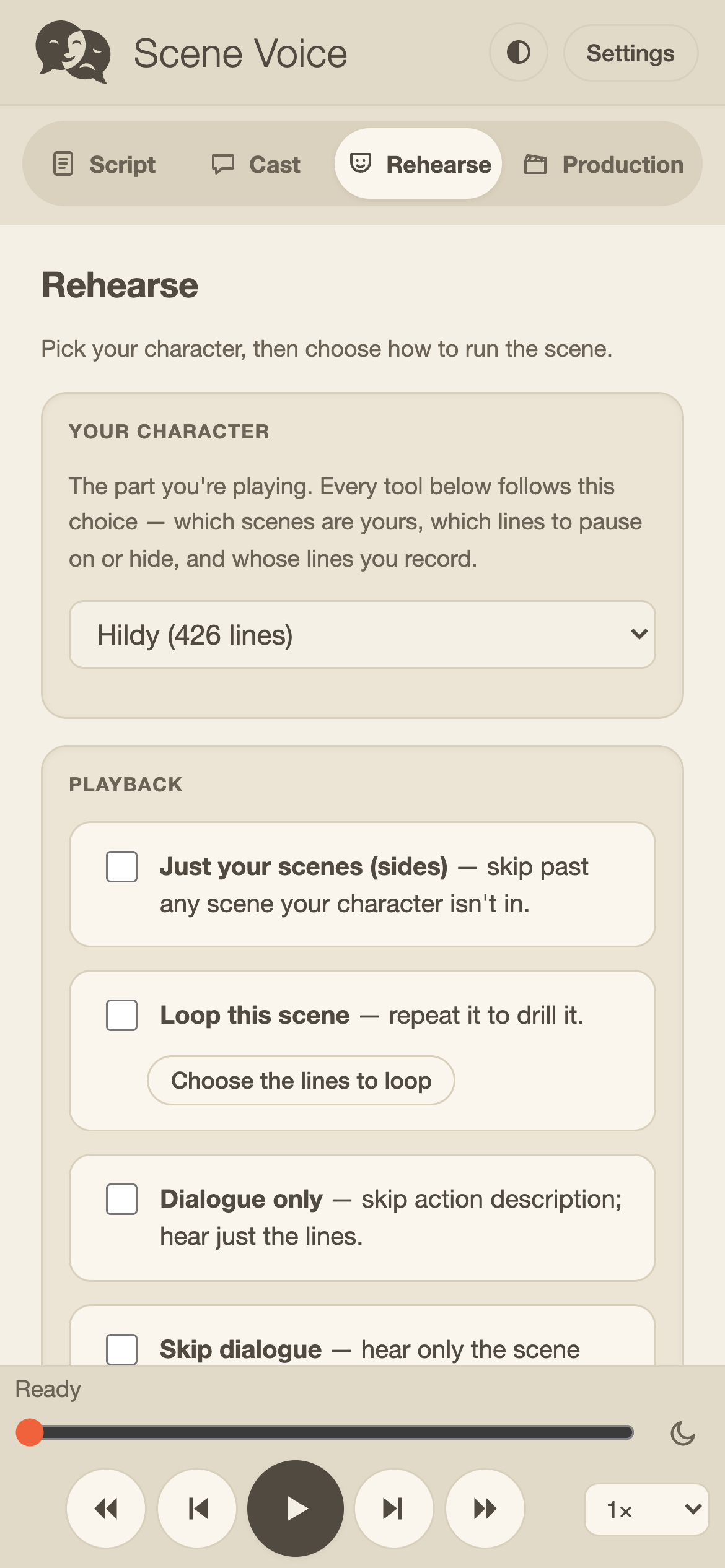
Scene Voice is an iPhone and iPad app we make for exactly this night. You import your sides or the whole script, as a PDF or Final Draft file, and every other character gets their own voice. Then:
- The reader waits for you. In Cue Me the app plays every part but yours and follows your words, using Apple’s speech recognition on the phone. When you finish your line it picks up, and if you stop it prompts you, so the scene runs at the speed you play it, and you can set your own pause after any of your lines.
- Your voice is recorded clean. In Self tape the other characters play in your headphones, so the microphone hears only you. They’re mixed into the video afterwards at full quality, at the level you choose, not played out loud and picked up from the room.
- The shot is ready when you are. Front or rear camera, a count-in, a dimmed picture or a teleprompter, and Start over without leaving the camera. The camera opens first so you can frame the shot, with zoom up to 3x, brightness and an eye-line guide, and the teleprompter sits under the lens. Every take is kept in the app to trim and clean up, then saved to Photos or sent, with no watermark on it (a Confidential script’s takes are only sent). Each take keeps its own reader level and voice cleanup.
- Your sides stay on your phone. The voices are made on the device. Nothing is uploaded, there’s no account, and the only copies that go anywhere are the ones you send yourself.
- Your own voice, if you want it. Record a line and it plays in place of the app’s voice, or have a scene partner record theirs and send you the file.
It’s in a free beta for iPhone and iPad right now. If you tape auditions, we’d love you to try it and tell us what gets in your way.
The short version
You don’t need a person in the room to make a tape that books. You need the other lines on the tape, a rhythm that follows you, an eyeline beside the lens, and a reader that stays quieter than you. Choose the option that gives you those tonight, then put everything you’ve got into the scene. That’s the part only you can do.
Still learning the lines? Read how to run lines by yourself.